For someone with hearing loss, a successful cochlear implant can be life-changing. But because outcomes vary, determining candidates most likely to benefit from the procedure is crucial.
A cochlear implant (CI) is a complex electronic device that can improve hearing in individuals with severe to profound hearing loss. While the implant does not restore normal hearing and differs from hearing aids, which amplify sounds, it does provide a useful representation of sounds by stimulating the auditory nerve. The device’s success depends on how well the auditory nerve functions.
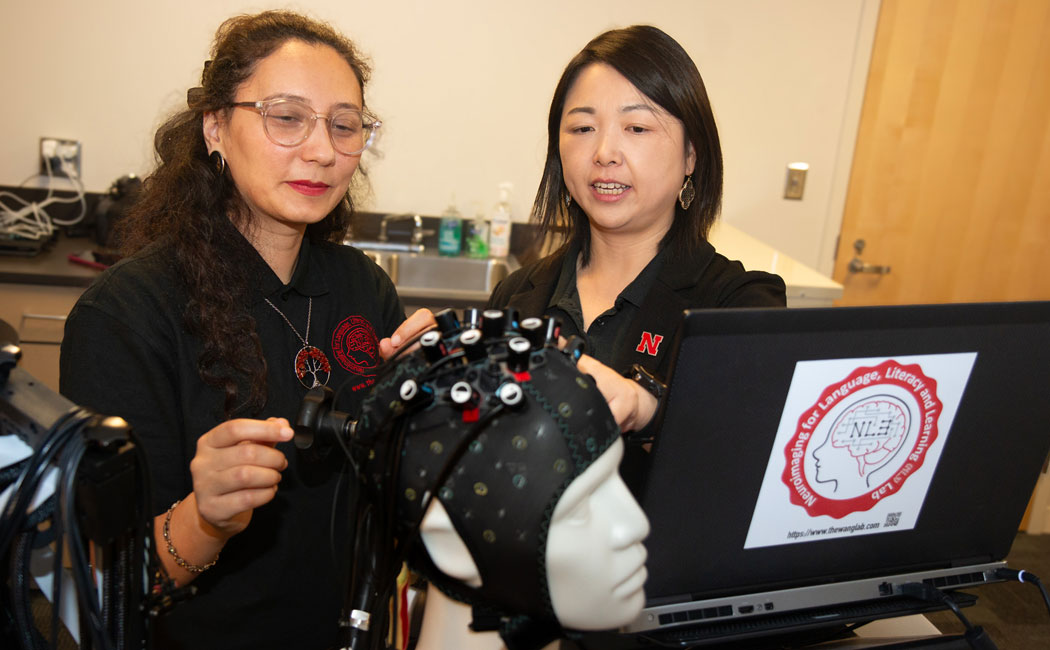
Yingying Wang, resident faculty of the Center for Brain, Biology and Behavior (CB3) and director of the Neuroimaging for Language, Literacy and Learning Lab (NL3), and a CYFS research affiliate, recently finished a three-year project to identify factors that determine the best candidates for successful CI procedures, and to explore relationships between the brain and speech perception outcomes — the process by which language is heard, interpreted and understood.
Collaborating with researchers at the University of Nebraska Medical Center and The Ohio State University, Wang and her team found age and hearing thresholds significantly affect the connectivity and network efficiency of the brain, and that visual analog of temporal envelope — a tool used to measure the brain’s sensory integration — benefits speech perception in moderately noisy environments for cochlear implant users.
Those findings, Wang said, highlight the importance of neuroimaging techniques such as resting-state functional magnetic resonance imaging (rs-fMRI) and functional near-infrared spectroscopy (fNIRS) in understanding the brain’s role in addressing hearing loss.
The study was funded by the National Institute on Deafness and Other Communication Disorders and housed at CYFS and CB3. Along with Wang and Hatch, the research team included co-PI Michelle Hughes, professor of special education and communication disorders; Jonathan Hatch, an otolaryngologist and assistant professor at UNMC who performed CI procedures; and Hongying (Daisey) Dai, UNMC associate professor, who served as the project’s statistician.
The project examined brain factors that may help predict future hearing improvements among implant candidates, and how the brain changes before and after cochlear implantation.
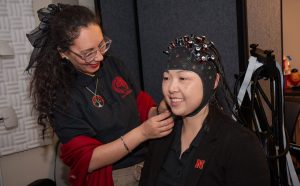
Before surgery, participants’ brain activity was measured to pinpoint areas that respond to speech sounds, and whether the auditory nerve was intact.
After implantation, researchers tracked changes in brain activity and speech perception at follow-up visits to clarify why some recipients have better speech perception.
Wang compared the adjustment to a cochlear implant to adapting to a new pair of eyeglasses. With an implant, the auditory cortex — the part of the brain that processes sound — must rewire itself.
“For people who have been deaf for years, this region has often been recruited for vision or touch,” she said. “Now sound signals are rushing in again, and the brain needs to relearn how to process them.”
The project’s greatest challenge, Wang said, was recruiting implant candidates. While the study featured 12 adults with severe-to-profound hearing loss who completed pre-surgical evaluations, only five completed post-surgical evaluations.
Because of the low number, Wang is seeking additional federal funding to expand the study with Ohio State partners collecting data from implant candidates in Columbus, Ohio. The Nebraska portion of the study would focus on participants for the comparison group.
Moving forward, Wang hopes to improve interventions by monitoring neuroplasticity — the brain’s ability to change and adapt to hearing loss or auditory changes.
“By examining the brain’s neuroplasticity, we may be able to determine pre-surgery interventions to benefit patients,” she said.
Learn more about the project in the CYFS Research Network.