For more than four years, the Nebraska State Personnel Development Grant (NSPDG) program has provided high-quality professional development for educators throughout the state to better support students with disabilities.
Recognizing that every school is different, the program offers tailored support to educators through in-person workshops, online learning, consultation and coaching support. It aligns with, and is implemented in conjunction with, Nebraska’s Multi-tiered System of Support, a framework to ensure every student can access learning experiences that enhance their educational outcomes.
Funded by a grant from the U.S. Department of Education, the program is led by Scott Eckman, program coordinator at the Nebraska Department of Education. Amanda Witte, CYFS research associate professor, has worked with Eckman and various other Nebraska educators, administrators and state agencies to adapt professional learning and educator development strategies within an integrated multi-tiered system of support (MTSS) framework.
Witte said the SPDG program offers an opportunity to “thoughtfully provide targeted professional development to Nebraska educators to enhance their use of evidence-based practices within their multi-tiered system of support.”
“The work is not only grounded in solid research evidence, but we are also gathering tons of information from our school partners to shape the professional development we deliver and assess its effect on adult and student outcomes,” she said.
As part of NSPDG, the NeMTSS team is supporting schools in adopting and implementing restorative practices, a systematic approach for building community, repairing harm and strengthening relationships. The approach focuses on empathy, accountability and dialogue rather than punishment.
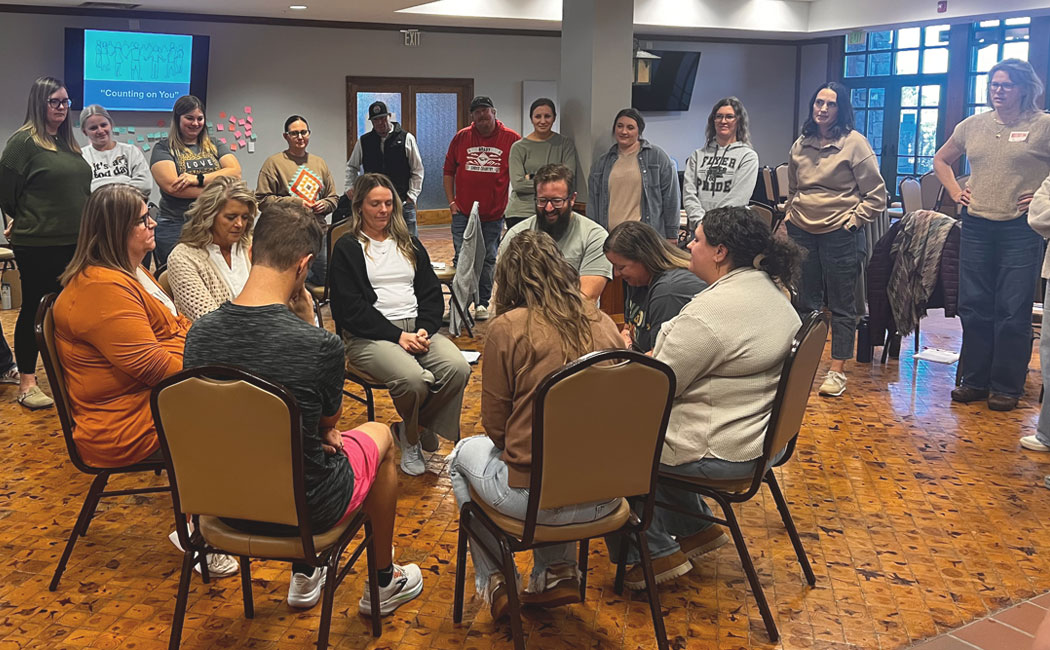
NeMTSS launched restorative practices training in 2024, partnering with Ali Hearn, a nationally known expert in promoting restorative practices within school systems. This collaboration supported Nebraska educators and administrators interested in adopting restorative practices in their schools and districts by offering three days of restorative practices training and opportunities for Community of Practice sessions — events during which educators and professionals share evidence-based practices, solve common challenges and improve student outcomes.
Preliminary analysis revealed a 36% increase in restorative practices implementation. Evidence from the first three training cohorts suggests that restorative practices training increases educators’ knowledge and implementation skills and promotes positive perceptions about restorative practices’ impact.
Also, districts participating in restorative practices training generally had lower rates of chronic absenteeism and suspensions after receiving restorative practices training.
Mackenzie Riedel, former NeMTSS Region 1 integrated support specialist, said restorative practices are integrated into current NeMTSS behavior systems, language and expectations.
“We want to embed restorative practices in continuous practices improvement; we don’t want it to be separate,” said Riedel, who provided restorative practices training to educators.
So far, she said, about 700 people statewide have been trained in restorative practices.
“Those who are coming to the training are excited,” Riedel said. “They’re inspired about the changes they can make.”
Recently, through the team’s collaboration with Lexington Public Schools, work with restorative practices has helped that community better weather the impact of the Tyson Foods plant closing Jan. 20, 2026. The plant’s closure affected 3,200 employees, most of whom are from Lexington.
We are excited about the data we have collected from districts and being able to use them. Some of our cohort school districts have presented their multi-tiered systems success at past NeMTSS Summits. Those presentations are opportunities to show other districts what’s possible.”
— Scott Eckman, program coordinator at the Nebraska Department of Education
One Lexington teacher reported that the training helped her better address the situation with fellow educators and others in the community. Some students said they were comforted by having a safe place to talk about their concerns.
“Lexington Public Schools have trained members of their staff to teach restorative practices, so there is commitment to the work,” Eckman said. “That shows a mindset of being a community that is coming together at a difficult time.
Eckman said a key component is ensuring sustained use of the multi-tiered systems is identifying exemplars — Nebraska schools and districts that are doing things well.
“We are excited about the data we have collected from districts and being able to use them,” he said. “Some of our cohort school districts have presented their multi-tiered systems success at past NeMTSS Summits. Those presentations are opportunities to show other districts what’s possible.”
Eckman notes that NSPDG has enabled growth among school districts and educational service units to develop a system where students get support quickly, which has led to better student outcomes. More training sessions for schools and districts across the state are planned.
“We’re focused on sustainability,” Eckman said. “Anything we try to accomplish is tied back to multi-tiered systems of support.”
Learn more about this project in the CYFS Research Network.