For the nearly 7 million American children who have been diagnosed with autism spectrum disorder and have not developed functional vocal speech, communication can be difficult — and frustrating.
One promising option is augmentative and alternative communication (AAC), including speech-generating devices that support, supplement or replace vocal speech. Research suggests that using AAC in early interventions through play and other everyday activities may enhance language, social communication and play skills in children with autism.
Ciara Ousley, assistant professor of special education and communication disorders, recently evaluated the effects of embedding AAC within storybook reading and play time with young children with autism, ages 2-5, who have limited to no vocal speech.
With funding from an Office of Research and Innovation Layman Seed Award, Ousley and her team blended naturalistic developmental behavioral intervention strategies — evidence-based teaching methods that combine applied behavior analysis principles with developmental and play-based strategies — with AAC to support social communication skills with young autistic children.
Researchers recruited young children diagnosed with autism with delayed communication skills. The children visited the Social Communication for Autism and Developmental Disabilities (SCADD) Lab, where 10-minute interactions with Ousley — either reading books or playing together, using AAC — were recorded and evaluated.
“It was eye-opening to me, because in my previous studies, the parents implemented the intervention I taught them,” she said. “This study put me in the driver’s seat as the person who was implementing the strategies, and I learned how difficult it is to navigate the AAC device, strategy use and play interaction at the same time.”
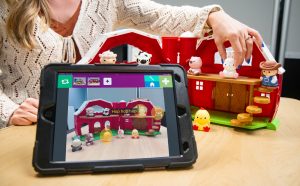
The project evolved to a smaller study focused on three children, all of whom had autism and none of whom used communication devices. Researchers introduced a Visual Scene Display (VSD), a type of AAC that uses photos of familiar, real-life situations to help children communicate.
Users can circle people, objects or other parts of a photo to hear embedded voice recordings with words or phrases linked to the photo. This visual approach supports communication without requiring children to search through word grids to find the correct vocabulary.
“We looked at whether the child’s engagement changed,” Ousley said. “Part of the challenge with AAC within play is that it’s difficult to integrate. You’re asking the child to stop interacting with the play and divert their attention to the communication device. We were curious about what would happen when VSDs were used.”
For example, the child had trains, blocks, farm animals and other toys available, and then were shown photographs of the same toys to explore whether the child changed their joint engagement — a developmental state where two individuals coordinate their attention toward the same object or event during a back-and-forth interaction.
Ousley found significant increases in children’s joint engagement levels when these strategies were introduced. When VSDs were added to play time, engagement remained consistent with no negative impacts.
“We also evaluated secondary measures,” she said. “When we added the VSD, the children’s symbolic turns were mixed, and the way the child chose to interact also changed. Some children increased their vocal speech when we showed the AAC device, while others increased their uses of the VSD itself as the communication mode.”
This study put me in the driver’s seat as the person who was implementing the strategies, and I learned how difficult it is to navigate the AAC device, strategy use and play interaction at the same time.”
— Ciara Ousley, principal investigator
In fact, one 4-year-old girl began creating her own VSDs during the study, taking photos of Ousley or toys and then adding different communication within the photographs.
“Although there is some research that shows kids can learn how to add VSDs, those data were from typically developing children,” Ousley said. “This was surprising and unexpected. She wanted to use a communication device to enhance her own creativity.”
Ousley plans to expand her research to gather data on what is happening in the homes during interactions among autistic children using AAC with a natural communication partner, such as parents or siblings, to identify the best ways to integrate AAC — and to develop strategies for adult parents, teachers and practitioners to help them enhance children’s communication.
“If I can train future teachers and future speech pathologists to train parents and family members, there are so many more children that can be helped,” she said.
Learn more about this project on the CYFS Research Network.