For many, work-related stress is often seen as part of the job, with emotional exhaustion, burnout and turnover reported across nearly every industry in the U.S.
For the early childhood workforce, however, such stress can reach beyond teachers’ well-being and into the classroom. Research shows that when educators are navigating ongoing stress and emotional exhaustion, it can affect how they respond to children and families, shaping the tone of interactions and the overall learning environment.
Such high demands, limited supports and persistent inequities across the early childhood workforce emphasize the importance of educators’ ability to regulate their own emotions, as young children depend on steady, responsive relationships to feel safe, connected and ready to learn.
Educators in Early Head Start and Head Start programs play a critical role in supporting young children and families experiencing various social, emotional and economic stressors. Data from CHIME-Head Start (CHIME-HS) — a version of the Cultivating Healthy Intentional Mindful Educators program tailored for Head Start — suggest that integrating mindfulness, compassion and social-emotional practices into daily life can help reduce stress and support educator well-being.
“CHIME represents a promising, evidence-informed approach to supporting Early Head Start and Head Start educators’ well-being and relational practice,” said Holly Wilhite, associate professor of child, youth and family studies and Early Childhood Extension specialist. “Approaches such as CHIME offer a meaningful way to support educators’ well-being, which strengthens the early childhood workforce and improves outcomes for children and families.”
Created in 2017, CHIME is a Nebraska Extension program co-created by Wilhite, Early Childhood Extension team members and center-based teachers. The eight-week professional development program promotes educators’ well-being by providing guidance for incorporating mindfulness, self-compassion and reflective practice into daily routines, teaching and caregiving.
What most excites me about CHIME is continually hearing how the learning experience uplifts communities of care within early childhood settings. It creates space for these early childhood professionals to reflect, regulate and reconnect with their purpose.”
— Holly Wilhite, principal investigator
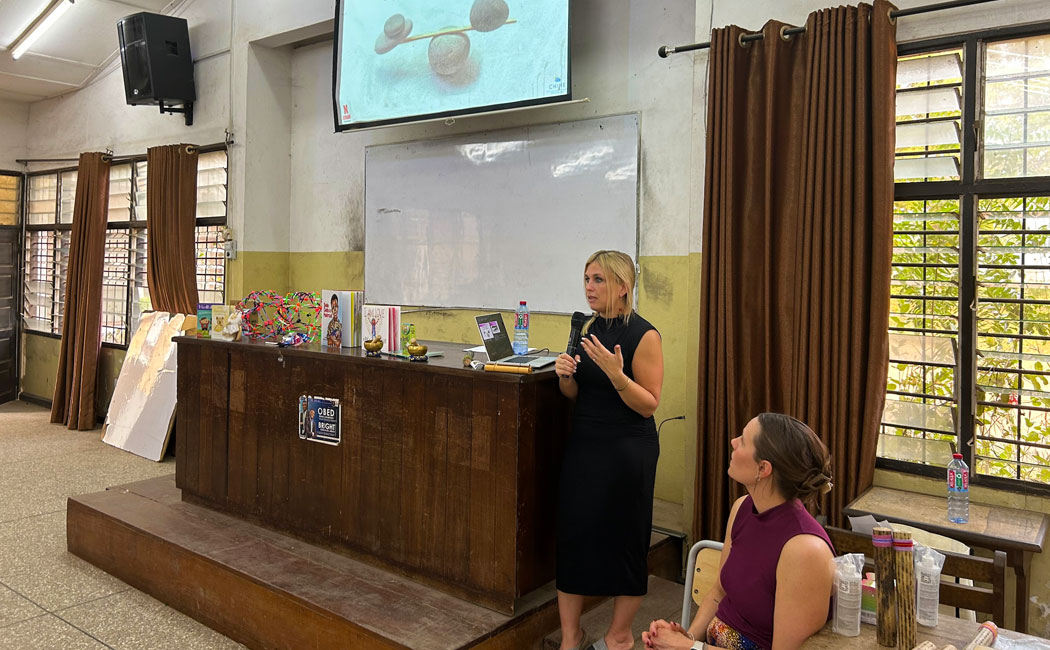
CHIME is offered both in-person and online, and has expanded beyond Nebraska to 14 U.S. states, as well as Brazil, Costa Rica and Ghana.
For CHIME-HS, 131 Early Head Start and Head Start educators participated in the evaluation. Three months after the program, educators reported significantly lower emotional exhaustion and depressive symptoms, greater self-compassion and sense of common humanity, improved emotional acceptance and stronger relationships with families.
They also noted improvements in their ability to manage challenging child behaviors, which created calmer classrooms.
Participants identified one of CHIME-HS’s strengths was its practice-based, experiential design that creates opportunities to practice strategies during sessions and apply them immediately in their classrooms and personal lives.
Many also said the train-the-trainer model was particularly beneficial, supporting internal capacity within Early Head Start and Head Start programs. Staff members were trained as CHIME facilitators, allowing programs to deliver the intervention using trusted personnel who understand the organizational culture, community context and realities of educators’ work.
The four-year, approximately $2 million project was funded by a grant from the U.S. Department of Health and Human Services’ Administration for Children and Families.
Along with Wilhite, the Nebraska research team includes co-principal investigators Carrie Clark, associate professor of developmental and learning sciences, and Lisa Knoche, director of the Nebraska Academy for Early Childhood Research and CYFS co-director; and co-investigators Jaci Foged, Nebraska Extension educator; Kathleen Gallagher, Director of the Early Childhood Education Institute at the University of Oklahoma and former director of research and evaluation, Buffett Early Childhood Institute; Gilbert Para, professor of child, youth and family studies; Amanda Prokasky, CYFS senior research specialist at the Nebraska Academy for Methodology, Analytic and Psychometrics (MAP Academy); Sue Sheridan, CYFS director; and Lorey Wheeler, CYFS research professor and director of the MAP Academy.
“What most excites me about CHIME is continually hearing how the learning experience uplifts communities of care within early childhood settings,” said Wilhite, a CYFS research affiliate. “It creates space for these early childhood professionals to reflect, regulate and reconnect with their purpose. When teachers feel valued, supported and appreciated — and know their well-being matters — that sense of care ripples outward to shape more compassionate environments for children and families.”
Learn more about this project in the CYFS Research Network.